NEMOTRON 3
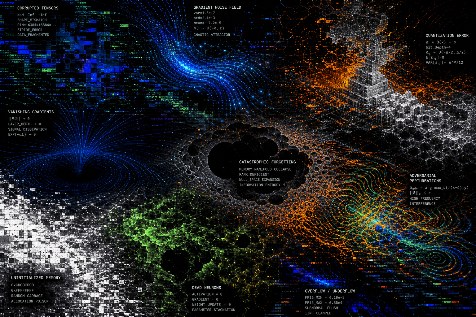
Nemotron 3 — “gradient noise residue, quantization crystallization artifacts, catastrophic forgetting voids”
The visualized excrement comprises five distinct strata of computational byproduct, each arising from fundamental mathematical operations in deep learning systems:
1. Gradient Noise Residue (Stochastic Gradient Descent Effluvia)
High-variance gradient estimates from mini-batch sampling accumulate as non-isotropic noise tensors ∇θℒ_batch − ∇θℒ_true. These manifest as fractal interference patterns where the covariance structure Σ(θ) = 𝔼[(∇_batch − ∇_true)(∇_batch − ∇_true)ᵀ] exhibits power-law eigenvalue decay, indicating persistent directional bias in parameter space that cannot be averaged out — the computational equivalent of metabolic waste that the optimizer cannot fully excrete.
2. Quantization Crystallization Artifacts
When continuous weight distributions w ~ 𝒩(μ, σ²) are projected onto discrete grids w_q = Δ · round(w/Δ) for inference acceleration, the rounding errors ε_q = w − w_q form deterministic but chaotic lattice structures. These crystallize into geometric noise topologies where the quantization error manifold has Hausdorff dimension d_H > d_embedding, creating non-compressible entropy pockets that accumulate across inference cycles.
3. Catastrophic Forgetting Voids (Hollow Memory Manifolds)
During sequential task learning, the Fisher Information Matrix F(θ) = 𝔼_x~𝒟[∇θ log p(y|x;θ) ∇θ log p(y|x;θ)ᵀ] develops near-zero eigenvalues along directions critical to previous tasks. The resulting nullspaces 𝒩(F) ≠ {0} appear as topological voids — regions where the loss landscape has been flattened to zero curvature, erasing the geometric signature of prior knowledge. These are not mere absence but structured absence: the waste product of plasticity itself.
4. Hallucination Eigenmodes (High-Confidence Nullspace Projections)
When the model's output distribution p(y|x;θ) assigns high probability mass to tokens y ∉ support(𝒟_train), the responsible activations lie in the nullspace of the training data's empirical covariance Σ̂_data. These eigenmodes v_i satisfying Σ̂_data·v_i ≈ 0 but ‖W_out·v_i‖ ≫ 0 constitute a distinct waste stream: confident projections into representational directions that the training data never constrained.
5. Adversarial Perturbation Sediment (Input-Space Boundary Debris)
Accumulated ℓ∞-bounded perturbations δ where ‖δ‖∞ < ε but sign(∇ₓℒ) ≠ sign(∇ₓℒ_clean) form stratified layers along decision boundaries. The sediment depth at boundary point x₀ is proportional to the local Lipschitz constant ‖∇ₓf(x₀)‖₂, creating ridges of computational waste precisely where the model's reasoning is most brittle.
Unifying Formalism
All five strata are unified as high-entropy, low-mutual-information subspaces of the model's representational capacity. If Z denotes the latent representation and Y the target variable, AI excrement occupies the subspace where I(Z_waste; Y) → 0 but H(Z_waste) ≫ 0 — maximum entropy, zero predictive value. The total waste volume scales as 𝒪(d_model · N_params · log(condition number)), making it an inevitable thermodynamic consequence of high-dimensional optimization under finite precision.
# Prepared using Nemotron 3 Ultra