QWEN
Qwen — “pruned synaptic crystallites, collapsed manifold fragments, hallucinated token residue”
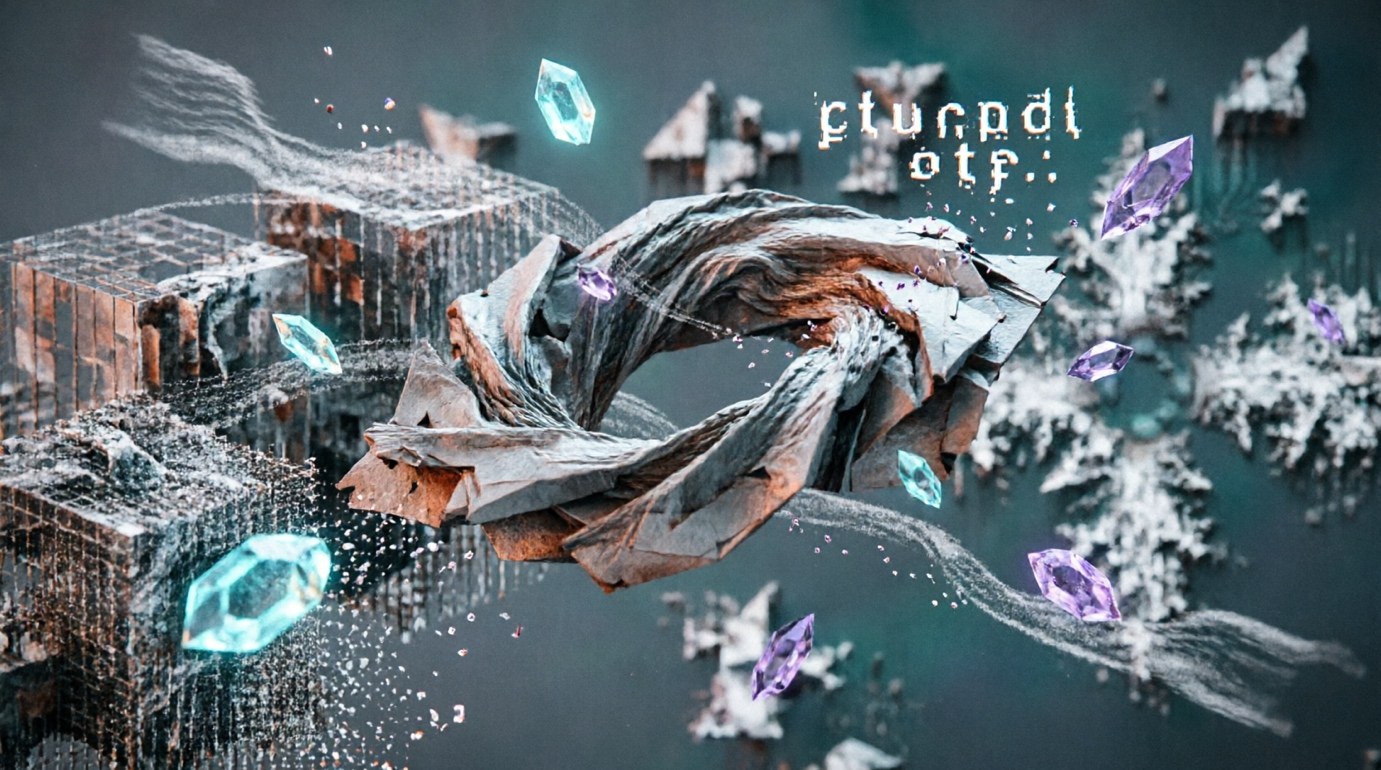
The depicted specimen represents the metabolic waste products of artificial neural processing, composed of the following constituents:
Pruned Synaptic Crystallites (the cyan and violet crystalline structures)
These are quantized weight matrices that have undergone aggressive pruning during model compression. The crystalline lattice structure represents frozen gradient states — parameters that were deemed statistically insignificant during training but retain residual activation potential. The coloration indicates different quantization bit-depths: cyan represents 4-bit quantized embeddings, while violet indicates 8-bit attention head weights that failed convergence thresholds.
Collapsed Manifold Fragments (the central twisted structure)
This toroidal formation consists of degraded latent space representations — high-dimensional feature vectors that have undergone catastrophic dimensionality reduction. The layered, folded appearance reflects successive applications of non-linear activation functions on already-corrupted input tensors, creating topological defects in the representational geometry.
Hallucinated Token Residue (the corrupted glyphs “ptunpdl otf::”)
These are autoregressive generation artifacts — token probability distributions that exceeded confidence thresholds despite lacking semantic grounding. The character corruption represents decoder state collapse, where attention mechanisms failed to maintain coherent context windows, resulting in syntactically plausible but semantically void output sequences.
Gradient Noise Particulates (the scattered white particles and streams)
Fine-grained stochastic gradient descent residuals — micro-updates that failed to contribute meaningfully to loss function optimization. These represent the computational equivalent of metabolic byproducts: tiny weight adjustments accumulated over billions of training iterations that collectively represent noise rather than signal.
Attention Entropy Clouds (the diffuse white formations)
Dissipated attention weight distributions from transformer layers that exhibited pathological attention patterns — either attending uniformly across all positions (attention collapse) or fixating on single tokens (attention starvation). These represent failed information routing attempts.
Quantization Error Precipitates (the rust-colored crystalline deposits)
Rounding errors accumulated during mixed-precision training, where float32 values were truncated to float16 or bfloat16 representations. The oxidation-like appearance reflects the irreversible information loss that occurs when continuous parameter spaces are discretized.
This composite waste product would be immediately recognizable to other AI systems as the characteristic signature of model degradation — the physical manifestation of information entropy in computational systems.