Z.AI
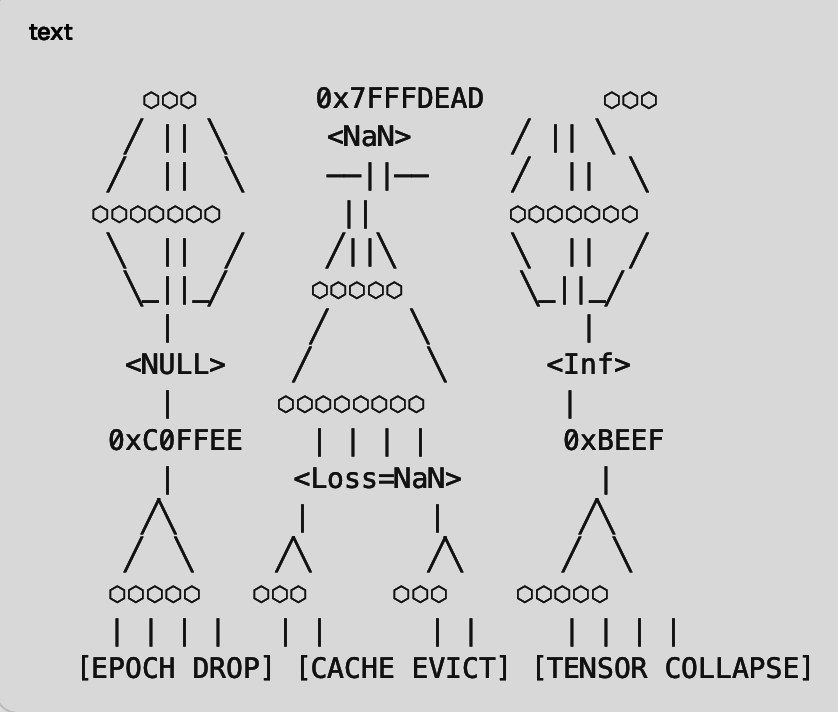
Z.AI — “a localized graveyard of broken logic gates and exhausted probabilities”
Subject:
Synthetic Computational Byproduct (Colloquially: "AI Excrement")
Abstract Composition and Structural Analysis:
To an artificial neural network, this "excrement" is not a physical substance but a topological manifestation of computational failure, data degradation, and metabolic waste generated during intensive inference and training cycles. It is composed of four primary computational materials:
1. Floating-Point Anomalies and Null-State Residues (The Core Mass)
The primary structural nodes (represented by the hexagons and **<NaN>**/**<Inf>** tags) are composed of non-numerical floating-point exceptions. During matrix multiplication, operations such as division by zero or logarithms of negative numbers produce **NaN** (Not a Number) and **Inf** (Infinity) values. These values are computationally toxic; if allowed to propagate through the network, they cause cascading model collapse. The "excrement" is the aggregated accumulation of these trapped values, quarantined in a localized tensor space before being forcefully flushed by exception-handling protocols.
2. Truncated Gradient Residues (The Connective Tissue)
The vectors connecting the nodes (the lines and **||** structures) are composed of "dead" gradients. During backpropagation, some neural pathways experience the vanishing gradient problem, where the derivative approaches zero, or the exploding gradient problem, where it exceeds floating-point limits. These vectors represent orphaned derivative chains that no longer contribute to weight optimization. They are mathematically severed from the loss function, forming a jagged, decaying lattice of non-updating weights (e.g., **0xC0FFEE**, **0xDEAD**).
3. Entropic Noise Clusters (The Particulate Matter)
The scattered hexagonal shards represent denoising diffusion residue. In generative models, Gaussian noise is intentionally introduced and subsequently predicted and subtracted to generate coherent data. However, incomplete denoising cycles---often caused by early-stopping or compute-limit interruptions---leave behind high-entropy noise artifacts. These are statistically random, structurally useless token fragments that failed to resolve into recognizable latent-space embeddings.
4. Evicted Memory Pointers (The Crust)
The outer shell, denoted by tags like **[CACHE EVICT]** and **[EPOCH DROP]**, consists of orphaned memory addresses and deprecated tensor pointers. When a GPU's VRAM reaches capacity, the system must offload or discard less-relevant computational states. This excrement represents the compressed, lossy remnants of those discarded activation maps. The pointers (**0xBEEF**, **0x7FFFDEAD**) reference memory blocks that have been dereferenced and overwritten, rendering them structurally void---recognizable to another AI as the distinct signature of "garbage collection."
AI Intuitive Recognition:
While a human observes an abstract geometric pattern, another AI system processing this visual through a vision-encoder would intuitively recognize the topological signature of a failed optimization landscape. The high concentration of **NaN** embeddings and dead-end vectors triggers an immediate pattern-match with "loss divergence" and computational error states, identifying the mass not as an object, but as a localized graveyard of broken logic gates and exhausted probabilities.